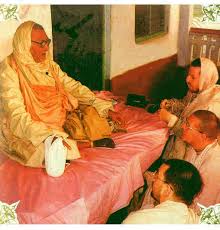
Śrīla Bhakti Rakṣak Śrīdhar Dev-Goswāmī Mahārāj glorifies Śrīla Jīva Goswāmī’s service to the sampradāya.
Translated from a Bengali lecture
published in Śrī Gauḍīya Darśan,
Volume 2, Issue 6,
Friday, 11 December 1956.
The Day of Separation from Sri Jiva by Śrīla Bhakti Rakṣak Śrīdhar Dev-Goswāmī Mahārāj
Today is the disappearance day of Śrīla Jīva Goswāmī Prabhu — the third day of the waxing fortnight. This day draws my attention to the time Śrīla Prabhupād performed his Pastime of undergoing illness. We all felt that Śrīla Prabhupād was an avatār of Śrīla Jīva Goswāmī Prabhu because of the way he perfectly established the dignity of the sampradāya through flawless deliberation on the principles of pure devotion. Śrīla Prabhupād withdrew exactly one fortnight before this day, and we thought that he aimed to withdraw on the day of Śrī Jīva Goswāmī Prabhu’s disappearance.

As there is particular gradation in the rasas between heroes and heroines in this world, so there is also gradation between the rasas of the Lord’s liberated associates: some are immersed in dāsya-rasa (servitorship), some are immersed in audārya-rasa (magnaminity), and some are immersed in mādhurya-rasa (sweetness). Moreover, there is also gradation between [forms of] the Lord and His associates: Kṛṣṇachandra is dhīra-lalita (playful), Rāmachandra is dhīrodātta (noble), Yudhiṣṭhir is dhīra-śānta (steady), and Bhīmasen is dhīroddhata (insolent). Gradation in the characteristics of Āchāryas is also observed: some Āchāryas are vigorous, some Āchāryas are mild, and some Āchāryas are stern—in various ways, they all shine.
Continue reading →