CC Madhya 13.136

CC Madhya 13.136
Ratha Yatra

āhuś ca te nalina-nābha padāravindaṁ
yogeśvarair hṛdi vicintyam agādha-bodhaiḥ
saṁsāra-kūpa-patitottaraṇāvalambaṁ
gehaṁ juṣām api manasy udiyāt sadā naḥ


Synonyms:
āhuḥ — the gopīs said; ca — and; te — Your; nalina-nābha — O Lord, whose navel is just like a lotus flower; pada-aravindam — lotus feet; yoga-īśvaraiḥ — by great mystic yogīs; hṛdi — within the heart; vicintyam — to be meditated upon; agādha-bodhaiḥ — who are highly learned philosophers; saṁsāra-kūpa — in the dark well of material existence; patita — of those fallen; uttaraṇa — for deliverance; avalambam — the only shelter; geham — in family affairs; juṣām — of those engaged; api — although; manasi — in the minds; udiyāt — let be awakened; sadā — always; naḥ — our.

Translation:
“[The gopīs spoke thus:] ‘Dear Lord, whose navel is just like a lotus flower, Your lotus feet are the only shelter for those who have fallen into the deep well of material existence. Your feet are worshiped and meditated upon by great mystic yogīs and highly learned philosophers. We wish that these lotus feet may also be awakened within our hearts, although we are only ordinary persons engaged in household affairs.’ ”

CC Madhya 13.76 – 80

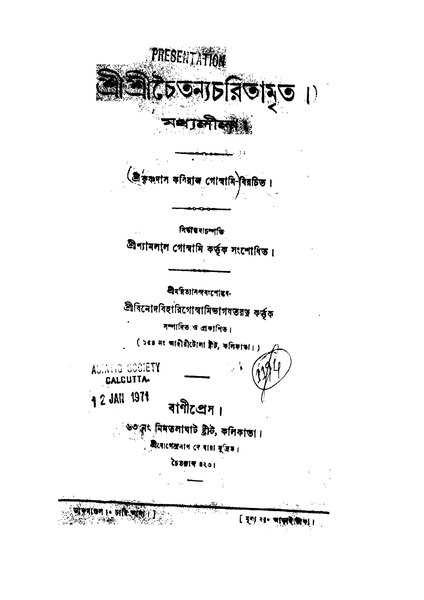
Shri Shri Chaitanya Charitamrita - Madhya Lila, Goswami, Krishnadas Kabiraj, 622p, LANGUAGE. LINGUISTICS. LITERATURE, bengali (1909)

Shri Shri Chaitanya Charitamrita – Madhya Lila, Goswami, Krishnadas Kabiraj, 622p, LANGUAGE. LINGUISTICS. LITERATURE, bengali (1909)

CC Madhya 13.76

daṇḍavat kari, prabhu yuḍi’ dui hāta
ūrdhva-mukhe stuti kare dekhi’ jagannātha

Synonyms:
daṇḍavat kari — offering obeisances; prabhu — Śrī Caitanya Mahāprabhu; yuḍi’ — folding; dui hāta — two hands; ūrdhva-mukhe — raising the face upward; stuti kare — offers prayer; dekhi’ — seeing; jagannātha — the Deity of Lord Jagannātha.

Translation:
Offering obeisances to the Lord with folded hands, Śrī Caitanya Mahāprabhu raised His face toward Jagannātha and prayed as follows.

CC Madhya 13.77

namo brahmaṇya-devāya
go-brāhmaṇa-hitāya ca
jagad-dhitāya kṛṣṇāya
govindāya namo namaḥ

Synonyms:
namaḥ — all obeisances; brahmaṇya-devāya — to the Lord worshipable by persons in brahminical culture; go-brāhmaṇa — for cows and brāhmaṇas; hitāya — beneficial; ca — also; jagat-hitāya — to one who always is benefiting the whole world; kṛṣṇāya — unto Kṛṣṇa; govindāya — unto Govinda; namaḥ namaḥ — repeated obeisances.

Translation:
“ ‘Let me offer my respectful obeisances unto Lord Kṛṣṇa, who is the worshipable Deity for all brahminical men, who is the well-wisher of cows and brāhmaṇas, and who is always benefiting the whole world. I offer my repeated obeisances to the Personality of Godhead, known as Kṛṣṇa and Govinda

Continue reading

Sri Jagannathastakam

Author: Adi Sankaracarya

Language: Sanskrit
Sri Chaitanya Mahaprabhu recited

LYRICS:

(1)
kadācit kālindī-taṭa-vipina-saṅgītaka-ravo
mudābhīrī-nārī-vadana-kamalāsvāda-madhupaḥ
ramā-śambhu-brahmāmara-pati-gaṇeśārcita-pado
jagannāthaḥ svāmī nayana-patha-gāmī bhavatu me

(2)
bhuje savye veṇuṁ śirasi śikhi-piccham kaṭi-taṭe
dukūlaṁ netrānte sahacara-kaṭākṣaṁ vidadhate
sadā śrīmad-vṛndāvana-vasati-līlā-paricayo
jagannāthaḥ svāmī nayana-patha-gāmī bhavatu me

Continue reading

Sri Gundicha Marjan Lila Rahasya

Śrīla Bhakti Siddhānta Saraswatī Goswami Ṭhākur explains the secret behind the cleansing of the Guṇḍichā Temple.

The Secret Behind the Pastime of Cleansing of the Guṇḍichā Temple

An English translation of Śrīla Bhakti Siddhānta Saraswatī Ṭhākur’s commentary on Śrī Chaitanya-charitāmṛta: Madhya-līlā, 12.135.

Through this Pastime, Jagad-guru Śrīman Mahāprabhu is teaching that if a fortunate soul desires to sit Kṛṣṇa on the altar of their heart, then they should first of all clean their heart of all contamination; making the heart spotlessly clean, peaceful, and resplendent with devotion is mandatory. If any thorny bushes, weeds, dust, or sand—anarthas—remain within the field of the heart, then the Lord, the ultimate recipient of all service, cannot be seated therein. Contamination and litter within the heart means anya-abhilāṣ (extraneous desires), karma (worldly action), jñān (speculative knowledge), yoga, and so on. Śrīla Rūpa Goswāmī Prabhu said,

anyābhilāṣitā-śūnyaṁ jñāna-karmādy-anāvṛtam
ānukūlyena kṛṣṇānuśīlanaṁ bhaktir uttamā
(Bhakti-rasāmṛta-sindhu: 1.1.11)

Wherever the soul’s eternal, natural propensity for devotion has been covered over by desires unrelated to devotion, speculative knowledge, worldly action, yoga, asceticism, or any mentality that is unfavorable to devotion, pure devotion is not present. And without pure devotion, which is by nature purely spiritual, Kṛṣṇa does not appear.

Continue reading

Slow and steady wins the race.

Ecstasy can exist by itself. Neither existence nor consciousness are complete in themselves. Consciousness alone hankers for ecstasy. And existence without consciousness is to exist with no purpose. Both existence and consciousness are subservient to ecstasy.

To come to the plane of ecstasy, we shall have to dive deep into reality. We must not be satisfied with the formal, superficial.

Our attitude should be one of humility, and if we think that we are being done wrong, still we should be patient, and under no circumstances should we work for our own position; that should be our aim.

Slow and steady wins the race. Our march towards the infinite is a long journey, not to be finished within a few hours, a few days, or a few years.

Continue reading

Trinad api sunicena

Sri Sarasvati Samlapa Conversation 8

Mahaprabhu taught us:
trnad api sunicena taror api sahiSriuna
amanina manadena kirtaniyah sada harih

“One who thinks himself lower than the grass, who is more tolerant than a tree, and who does not expect personal honor but is always prepared to give all respect to others, can very easily always chant the holy name of the Lord.”

As long as we remain humbler than a blade of grass, we will be able to perform hari-kirtana. The moment we try to become “bigger” or “greater,” we will have to say goodbye to kirtana.

Maya means – that which is not

Maya means “that which is not.”

That which is, the positive, is God. The negation of the positive, God, is the negative, or maya. As soon as we connect the negative maya to the positive, personal God, considering ourselves God, we give birth to self-worship.

Continue reading

Love your environment

Love your environment. Sincerely try to love one another and you will find yourself in Vrindaban, Chintamani Dham, the land of Krishna, under His guidance.

Just try to find your sweet self within that domain. There you will live in sweetness where all movement is like dancing and speech is a song, the water is nectar and the trees are kalpataru – whatever you like they are giving to you. Your innermost self is entitled to live in that divine civilization.

— Ideal Reality

Divine Words of His Divine Grace Srila Bhakti Raksaka Sridhar Deva Goswami

When service is added to consciousness

A sweet structure begins from the point when service is added to consciousness. Service can construct a beautiful capital, a beautiful country.

It is there, and you have only to feel it, enter, and take up your appointed service.

You will think: “This is my home! This appointment feels very friendly to me. Now I have come home.”

Divine Words of His Divine Grace Srila Bhakti Raksaka Sridhar deva Goswami

Continue reading