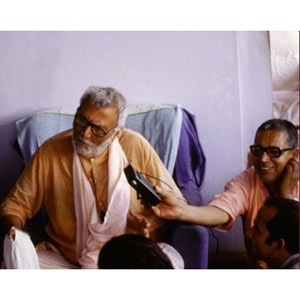
Sri Caitanya Bhagavat and Srila Vrindavan Das Thakur

About Sri Caitanya Bhagavat and Srila Vrindavan Das Thakur

Srila Bhaktisiddhanta Saraswati Goswami Prabhupad

চৈতন্য নিতাই কথা, শুনিলে হৃদয়-ব্যথা
চিরতরে যায় সুনিশ্চিত।
কৃষ্ণে অনুরাগ হয়, বিষয়ে আসক্তি যায়
শ্রোতা লভে নিজ-নিত্য-হিত।।

By listening to discussion of Caitanya and Nitāi, all pain in the heart most certainly goes away for good. Devotion to Kṛṣṇa manifests and attachment to the sense objects goes away. Listeners attain their eternal welfare.

ভাগবতে কৃষ্ণ কথা, ব্যাসের লেখনী যথা
তার মর্ম বৃন্দাবন জানি।
শ্রীচৈতন্য ভাগবতে, বর্ণে অনুরূপ-মতে
গৌর-কৃষ্ণে এক করি মানি।।

Understanding the essence of the discussion of Kṛṣṇa from the pen of Vyāsa in Śrīmad Bhāgavatam, Vṛndāvana Dāsa described Gaurakṛṣṇa in Śrī Caitanya-bhāgavata accordingly, consider Him one (with Śrī Kṛṣṇa).

গৌরের গৌরব লীলা, শুদ্ধতত্ত্ব প্রকাশিলা
যে নিতাই দাস বৃন্দাবন।
তাঁহার পদাব্জ ধরি, অনুক্ষন শিরোপরি
গৌড়ীয় ভাষ্যের সঙ্কলন।।

Vṛndāvana Dāsa manifests the pure nature of Nitāi and His līlā of honoring Gaura. Holding His lotus feet
continuously atop my heard, I compile this Gauḍīya-bhāṣya.

শ্রীচৈতন্য ভাগবত , লীলা মণি মরকত
চৈতন্য নিতাই কথা সার।
শুনে সর্বক্ষণ কর্ণে, সহস্র-মুখেতে বর্ণে
গ্রন্হরাজ মহিমা অপর।।

Śrī Caitanya-bhāgavata is an emerald of jewel-like līlā and discussion of Caitanya and Nitāi are its essence. It is heard constantly by the ears and described by thousands of mouths. The greatness of this king of scriptures is boundless.

(From Sri Caitanya Bhagavat Gaudiya Bhasya)

Fully Satisfied, Fully Surrendered

Śrīla Bhakti Rakṣak Śrīdhar Dev-Goswāmī Mahārāj remembers his dear friend Śrīpād Kṛṣṇa Dās Bābājī Mahārāj.

We know that Kṛṣṇa Dās Bābājī Mahārāj has left this world. We would like to remember his life and activities as much as possible. I first met him in 1926 or so. I found him shortly after I joined Gauḍīya Maṭh. He returned from a preaching tour with Bhāratī Mahārāj at that time. He was young, smart, beautiful, jolly, and very firm in his principles, especially towards Nām-bhajan. He came from a respectable, high family from Dacca, [Munchi Ganga?], which at present is in Bangladesh. At that time it was all part of Bengal in British India. I next saw him when he came back with a preaching party from Naimiṣāraṇya and western parts of India with Bon Mahārāj. Some natural friendship grew between us. Perhaps our similar high social rank, similar education, similar simplicity, and similar earnestness for Kṛṣṇa consciousness brought us together, gradually and intimately. I had a closer connection with him in the latter part of ’27 in New Delhi.

For a few weeks, we were allowed to work together there and our intimacy grew. Then, towards ‘29 or so, he was in [Bali Hati?] in Bengal in a village Maṭh going on with his Nām-bhajan. I made a request to Prabhupād, “He is an educated young man. His service may be very useful at present for preaching in New Delhi. If you allow, I will ask him to come and join me in my activities.” I was then Maṭh commander in New Delhi; through me, the Maṭh was founded there.

Prabhupād gladly gave his consent: “If you can take him and engage him in preaching service for Mahāprabhu, then you will do the work of a great, a real, friend to him.”

Continue reading

About Jiva Tattva

Divine Words of Guardian of Devotion

Consciousness means to be endowed with free will. Without free will, no consciousness can be conceived. Consciousness means free will. This individual point of consciousness (jiva) means very meager free will. By the exercise of his free will, the jiva is asserting itself. It may go that side (Vaikuntha), or this side (the land of exploitation). Some jivas are going that side; some are coming to this side from the marginal plane.

Free will is the first action of coming into the land of exploitation. It is by free choice. Svabhava, or independence, is already there in the jiva – the very nature is there. But as the resulting consequence, we see that some jivas have taken their chance on this side. They did not accept submission, but wanted to dominate. With this germinal idea of domination, the jiva enters into the world of exploitation. The consequence of exploitation is added to his free will, then that is the basis of all these developments in variegated nature. The original starting point is like that — the vulnerability of the free thinkers. Free thinking is vulnerable because it is very meager, small, anu-caitanya, anu-svairiatva – limited freedom, limitation of free will. That is the cause of this world.

Maya is automatically the effect of the outcome of the vulnerable free will of the jiva. The world exists, just as the prison house exists due to evil desires for the encroachment on another’s property. If that misdeed is absent, then the prison house is absent. Prison houses are necessary. Kara-kartr – Durga-devi is kara-kartr. It is mentioned in Brahma-samhitachayeva yasya bhuvanani vibharti durgaKara-kartr – prison keeper.  Why prison?  There are prisons because there is a vulnerability in the choice of freedom, leading to encroachment on another’s property. Otherwise, no world is necessary. But because it is possible, prison houses are there. If the disease is absent, hospitals are absent. No disease — no hospital. No crime — no prison house. No misuse of free will – no world!

No blame for the existence of this world or our suffering should be put on the shoulders of Krsna, nor on Maya. You and you alone are responsible for your own suffering. You are weak — your thinking, your capacity, your everything is weak.

Once in Puri, one gentleman came to our Guru Maharaja, Bhaktisiddhanta Sarasvati Thakura Prabhupada, and put a question:

How did our life in bondage begin? How it first started? Who is responsible – God, Maya, or jiva? There are three factors –God is there with His paramount power, Maya is there which comes to capture the jiva, and the jiva is independent we are told. Then how did it begin? What was the first cause of such a beginning – the jiva’s contact with the world? The jiva is free, and God is, of course, absolutely free and Maya is there. Maya is playing with us. But when it first starts, who is responsible?

Continue reading

Vaishnava Aparadhas

pujito bhagavan visnur janmantara satair api
prasidati na visvatma vaisnave ca apamanite

(Hari Bhakti Vilasa 10.315, from Dvaraka Mahatmya, conversation between Prahlada Maharaja and Bali Maharaja)

Any person who has criticized a Vaisnava, such sinners, even if they worship Lord Sri Visnu, the source of the whole world for hundreds of births, with such insulters of Vaisnavas, Lord Hari does not remain happy.

Skanda Purana lists six kinds of Vaisnava aparadhas (offenses):

hanti nindati vai dvesthi
vaisnavan na abhinandati
krudhyate yati no harsam
darsane patanani sat

Continue reading

Srimad Bhagavatam 11.2.42

Srimad Bhagavatam 11.2.42

भक्ति: परेशानुभवो विरक्ति-
रन्यत्र चैष त्रिक एककाल: ।
प्रपद्यमानस्य यथाश्न‍त: स्यु-
स्तुष्टि: पुष्टि: क्षुदपायोऽनुघासम् ॥ ४२ ॥

bhaktiḥ pareśānubhavo viraktir
anyatra caiṣa trika eka-kālaḥ
prapadyamānasya yathāśnataḥ syus
tuṣṭiḥ puṣṭiḥ kṣud-apāyo ’nu-ghāsam

When we are weak, dissatisfied, and hungry, we have the tendency, we have earnestness, to eat. Similarly, by our bhajan, after the surrender, the transaction that will go on will give us three things.

1. Bhaktiḥ: the tendency for divine service will increase with accelerated motion.

2. Pareśānubhavo: we will come to some conception of what is reality proper—what is Brahma, what is Paramātma, what is Nārāyaṇ, what is Kṛṣṇa, what is sat, what is chit, what is ānandam. We will have some sort of conception of all these principles and feel that we are advancing.

3. Viraktir anyatra: our indifference for other things than what is holy will increase.

Our withdrawal from the mundane world, from non-God and non-holy things, will also increase.
Just as when we take food, with every morsel our hankering for eating, and our weakness, decrease, and we feel satisfaction, so too we shall experience in our heart our progress towards our holy object…

The Significance of Mahaprasad

The Significance of Mahaprasad
by Srila Bhaktivinoda Thakur

The system of Mahaprasad is not only emblematic of the superior life of the Vaishnavas, but it is a part of the worship which ordinary theists cannot fully understand. The ordinary men are very much inclined to preserve the superiority of Reason over the intuitive feelings of man towards the God of Love. We must now proceed to show with healthy arguments that our intuitive feelings want us to offer everything we eat to the God of our heart.

We must first examine the arguments of the antagonists. The Rationalist holds that God is infinite and without wants, and consequently it is foolish to offer eatables to such a Being. It is a sacrilege to offer created things to the Creator and thereby degrade the Divinity of God into humanity. These are reasonable arguments indeed, and one who has heard them will certainly be inclined to declare to others, “Down with the Mahaprasad”. These conclusions, however reasonable, are dry and destructive. They tend to separate us from all connections with God in the form of worship. When you say that the Infinite wants nothing, you forbid all contemplation and prayer. The Infinite does not want your grateful expressions or, in other words, flattery. Utter a word to the Unconditioned and you are sure to degrade Him into a conditioned Being. Hymns, prayers and sermons are all over! Shut your temple door and the church gates, because our Rationalist has advised you to do so. Believe a creating principle and you have done your duty! Oh! What a shame! What a dreadful fall! Theists, beware of these degrading principles!

Now the Rationalist appears in another shape and admits prayers, sermons, psalms and church-going, saying that these things are wanted for the improvement of the soul, but God does not want them at all. We are glad that the Rationalist has come towards us and will make further approaches in the course of time.

Continue reading

The solution of our life

Srila Sachchidananda Bhaktivinoda Thakur himself said:

Many things are going on in religion in the name of the solution of our life, but what Mahaprabhu has given very soon will be detected by the intelligentsia of the world, and all will flock to the banner of Sri Chaitanyadev and will sing the glory of Mahaprabhu and Krshna.

Mercy of Lord Sri Rama

Lord Sri Rama is so compassionate and merciful.

In Sri Sri Prapanna-jivanamritam, Srila Bhakti Raksak Sridhar Dev-Goswami Maharaj writes:

“If one seeks refuge in Him just once, He awards fearlessness to the person forever”

and quotes a verse from the Ramayana:

sakrd eva prapanno yas tavasmiti cha yachate
abhayam sarvada tasmai, dadamy etad vratam mama

(Sri Sri Prapanna-jivanamritam: 9.4)

“It is my pledge that if anyone just once sincerely petitions Me for shelter, saying, ‘I am Yours,’ then I grant him courage for all time to come.”

Absolute compassion of Sri Caitanyacandra

prema namadbhutarthah sravanapathagatah kasya namnam mahimnah
ko vetta kasya vrndavanavipina-mahamadhurisu pravesah
ko va janati radham paramrasacamatkarmadhuryasimam
ekascaitanyacandrah paramkarunayah sarvvamaviscakara

Translation:

Had anyone ever heard of something known as Prema, as the ultimate aim of mankind?
Did anyone know of the divine power of the holy name?
Had anyone entered the sweet, charming forest of Vrindavana?
Did anyone know of Sri Radha as the embodiment of the highest transcendental ecstasy, worthy of loving adoration?
Only due to the absolute compassion of Sri Caitanyacandra were these rarest gems discovered, found shimmering in the darkness of Kaliyuga, lit by the moonlight of his benevolence.

From Caitanya Candramritam

Srimad Bhagavatam 10.82.48

Srimad Bhagavatam 10.82.48

आहुश्च ते नलिननाभ पदारविन्दं
योगेश्वरैर्हृदि विचिन्त्यमगाधबोधै: ।
संसारकूपपतितोत्तरणावलम्बं
गेहं जुषामपि मनस्युदियात् सदा न: ॥ ४८ ॥

āhuś ca te nalina-nābha padāravindaṁ
yogeśvarair hṛdi vicintyam agādha-bodhaiḥ saṁsāra-kūpa-patitottaraṇāvalambaṁ
gehaṁ juṣām api manasy udiyāt sadā naḥ

Translation:

The gopīs spoke thus: Dear Lord, whose navel is just like a lotus flower, Your lotus feet are the only shelter for those who have fallen into the deep well of material existence. Your feet are worshiped and meditated upon by great mystic yogīs and highly learned philosophers. We wish that these lotus feet may also be awakened within our hearts, although we are only ordinary persons engaged in household affairs.