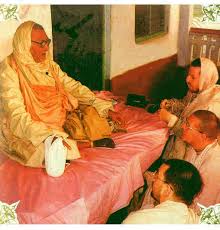
Divine words of His Divine Grace

Divine words of His Divine Grace
Srila Bhakti Rakshaka Sridhar Dev Goswami

The siksa-guru parampara should be considered the most substantial thing. Eliminating the sahajiya-vada which gives much importance to the outer cover, try to look within, and see things more deeply. Try to understand the deeper vibrations of the outside environment, and see within yourself also. Dive deep, and you will find the plane of the finest vibration which will carry that news to you, and you will see that truth.

We are slaves of the truth. We are beggars for the pure current of truth that is constantly flowing: the fresh current. We are not charmed by any formality. I will bow down my head wherever I find the river of nectar coming down to me.

Maya means ‘local interest’, to see things or read the environment by local interest, not from the standpoint of universal interest.

So if my inner voice, my spiritual conscience decides that a type of company cannot really help me, then I will be under painful necessity to give it up, and to run away towards my destination, in the direction that my spiritual conscience guides me. Otherwise it will be hypocrisy, and it will check our real progress.

Continue reading

Science of Devotion Proper

Real progress towards the Infinite gives the idea that, “I am nothing, I am in great danger.” Progress towards the Infinite is like that. Thinking, “I have it, I am above,”—this is a foolish feeling, a foolish statement. The very nature of advancement is that, “I am low, I am undone, I am the most helpless.” The closer we are, the further away we will feel, whereas the further away we actually are from divinity, we may complacently feel we are close. As much as we come into the relativity of the Infinite, we cannot but conceive ourselves to be the lowest of the low.

That is the criteria.

The very sign of real progress will show I am nothing, I am the most needy, the most wretched and the most helpless. The negative aspect must be improved to attract the positive. If one point of the negative will say, “I am positive” then immediately it will be rejected, you are under the false control of måyå.

His Divine Grace Srila Bhakti Raksak Sridhar Dev-Goswami

Glories of Sri Gauranga

Herein lies the secret of secrets which the living entities bound by Maya cannot discern. One who does not attain love of God after worshipping Krishna birth after birth has certainly committed heaps of offenses. For only by chanting Krishna’s name without offenses can one attain incessant Krishnaprema. Sri Chaitanya’s incarnation, however, is most uncommon. By His mercy, a serious person, though filled with offenses, can quickly obtain love of God. When someone calls out the names of Nitai and Chaitanya, Krishna-prema comes looking for him. Offenses do not hinder his progress, and he soon sheds tears of ecstasy out of pure love of God. By the mercy of Sri Chaitanya, all the offenses quickly flee away, the heart becomes pure, and love of God fully blossoms. Because people in Kali-yuga commit unlimited offenses, which are difficult to check, there can be no means of deliverance other than Gauranga’s name. Therefore, in Kali-yuga, I see no alternative to Sri Gauranga. This is also the proclamation of the scriptures.

— Sri Nabadwip Dham Mahatmya

Signs of ecstatic emotion

Sri Chaitanya Charitamrita - Adi Lila Krishnadas Kabiraj bengali 1915

Sri Chaitanya Charitamrita – Adi Lila Krishnadas Kabiraj bengali 1915

kshāntir avyartha-kālatvam
viraktir māna-śūnyatā
āśā-bandhah samutkanthā
nāma-gāne sadā rucih

āsaktis tad-gunākhyāne
prītis tad-vasati-sthale
ity-ādayo 'nubhāvāh syur
jāta-bhāvāńkure jane

“‘When the seed of ecstatic emotion for Krishna fructifies, the following nine symptoms manifest in one’s behavior: forgiveness, concern that time should not be wasted, detachment, absence of false prestige, hope, eagerness, a taste for chanting the holy name of the Lord, attachment to descriptions of the transcendental qualities of the Lord, and affection for those places where the Lord resides — that is, a temple or a holy place like Vrindāvana. These are all called anubhāva, subordinate signs of ecstatic emotion. They are visible in a person in whose heart the seed of love of God has begun to fructify.’

(CC.23.m 18-19)

Day of Separation from Sri Jiva Goswami

Śrīla Bhakti Rakṣak Śrīdhar Dev-Goswāmī Mahārāj glorifies Śrīla Jīva Goswāmī’s service to the sampradāya.

Translated from a Bengali lecture
published in Śrī Gauḍīya Darśan,
Volume 2, Issue 6,
Friday, 11 December 1956.

The Day of Separation from Sri Jiva by Śrīla Bhakti Rakṣak Śrīdhar Dev-Goswāmī Mahārāj

Today is the disappearance day of Śrīla Jīva Goswāmī Prabhu — the third day of the waxing fortnight. This day draws my attention to the time Śrīla Prabhupād performed his Pastime of undergoing illness. We all felt that Śrīla Prabhupād was an avatār of Śrīla Jīva Goswāmī Prabhu because of the way he perfectly established the dignity of the sampradāya through flawless deliberation on the principles of pure devotion. Śrīla Prabhupād withdrew exactly one fortnight before this day, and we thought that he aimed to withdraw on the day of Śrī Jīva Goswāmī Prabhu’s disappearance.

As there is particular gradation in the rasas between heroes and heroines in this world, so there is also gradation between the rasas of the Lord’s liberated associates: some are immersed in dāsya-rasa (servitorship), some are immersed in audārya-rasa (magnaminity), and some are immersed in mādhurya-rasa (sweetness). Moreover, there is also gradation between [forms of] the Lord and His associates: Kṛṣṇachandra is dhīra-lalita (playful), Rāmachandra is dhīrodātta (noble), Yudhiṣṭhir is dhīra-śānta (steady), and Bhīmasen is dhīroddhata (insolent). Gradation in the characteristics of Āchāryas is also observed: some Āchāryas are vigorous, some Āchāryas are mild, and some Āchāryas are stern—in various ways, they all shine.

Continue reading

Sri Uddharana Datta Thakur

Uddharana Datta was the best of the Bhagavatas, who served Nityananda’s lotus feet in every way possible.
Chaitanya Charitamrita 1.11.41

Whenever the Supreme Divinity, Nandanandan Sri Krishna, adopts the devotional mood and bodily luster of Srimati Radharani in order to become Sri Krishna Chaitanya, He is always accompanied by His eternal associates, who join Him in order to enrich His pastimes. Thus, Krishna’s primary expansion or prakasa, Baladev, accepts the attitude of a devotee as Sri Nityananda Prabhu, appearing in Ekachakra village in order to embellish Mahaprabhu’s lila. He too has his entourage of personal confidantes who descend to this earth to assist him in playing his role. Nityananda is Baladeva Tattva: he is none other than Lord Sesa, the source of three purusavataras, Maha Sankarshan’s causal form or mula Sankarshan. His chief companions are known as the Dvadasa-gopalas or twelve cowherds. Thus it is stated in the Gaura-ganoddesa-dipika (129):

Subahur yo vraje gopo data uddharanakhyakah
The Cowherd Named Subahu Became Uddharan

Uddharana Datta Thakur is thus one of the Twelve Gopals.
Continue reading

Bhagavata-dharma taught by Sri Caitanya

If we were to prepare a list of worldly religions born of human knowledge, and if according to that list we analyzed how they formed their conceptions and conclusions, we would understand that other than the sanatana-dharma taught in Srimad-Bhagavatam – the religion Sri Caitanyadeva preached – all other man-made religious systems are full of imagination, concoction, and cheating. Only bhagavata-dharma, or Sri Caitanyadeva’s pure atma-dharma, is free of cheating. Bhagavata- dharma is the eternal Vedic religious system, approved and followed by the supremely nonenvious, swanlike saints. The religious systems of today are imagined by men; they are created by the human mind. None of them is atma-dharma. Sri Caitanya-caritamrta (Madhya 25.45) states:

caitanya-gosani yei kahe, sei mata sara
ara yata mata, sei saba charakhara

“Whatever meaning Sri Caitanya Mahaprabhu gives is perfect. Any other interpretation is only a distortion.”

Vaktitavali by Srila Bhaktisiddhanta Sarasvati Goswami Thakura Prabhupada

Uddhava-Gita 17.42

Udhava GitaUddhava-Gita

TEXT 17.42|| SB 11.23.42 ||

dvija uvāca
nāyaṁ jano me sukha-duḥkha-hetur
na devatātmā graha-karma-kālāḥ
manaḥ paraṁ kāraṇam āmananti
saṁsāra-cakraṁ parivartayed yat

The brahmana said: These people are not the cause of my happiness and distress. Neither are the demigods, my own body, the positions of the planets, my karma, or time. Rather, it is the mind alone that causes happiness and distress and perpetuates one’s bondage to the vicious cycle of repeated birth and death.

Continue reading

Srimad Bhagavatam 5.18.12

यस्यास्ति भक्तिर्भगवत्यकिञ्चना
सर्वैर्गुणैस्तत्र समासते सुरा: ।
हरावभक्तस्य कुतो महद्गुणा
मनोरथेनासति धावतो बहि: ॥ १२ ॥

yasyāsti bhaktir bhagavaty akiñcanā
sarvair guṇais tatra samāsate surāḥ
harāv abhaktasya kuto mahad-guṇā
manorathenāsati dhāvato bahiḥ

Synonyms
yasya — of whom; asti — there is; bhaktiḥ — devotional service; bhagavati — to the Supreme Personality of Godhead; akiñcanā — without any motive; sarvaiḥ — with all; guṇaiḥ — good qualities; tatra — there (in that person); samāsate — reside; surāḥ — all the demigods; harau — unto the Supreme Personality of Godhead; abhaktasya — of a person who is not devoted; kutaḥ — where; mahat-guṇāḥ — good qualities; manorathena — by mental speculation; asati — in the temporary material world; dhāvataḥ — who is running; bahiḥ — outside.

Translation
All the demigods and their exalted qualities, such as religion, knowledge and renunciation, become manifest in the body of one who has developed unalloyed devotion for the Supreme Personality of Godhead, Vāsudeva. On the other hand, a person devoid of devotional service and engaged in material activities has no good qualities. Even if he is adept at the practice of mystic yoga or the honest endeavor of maintaining his family and relatives, he must be driven by his own mental speculations and must engage in the service of the Lord’s external energy. How can there be any good qualities in such a man?

Shri Krishnasya mahima

ambhodhih sthalatam sthalam jaladhitam dhuli-lavah shailatam
shailo mrit-kanatam trinam kulishatam vajram trina-kshinatam
vahnih shitalatam himam dahanatam ayati yasyecchaya
lila-durlalitadbhuta-vyasanine krishnaya tasmai namah

I offer my respectful obeisances to wonderful, playful, mischievous Krishna who, if He desires, can make an ocean dry land, dry land an ocean, a blade of grass a thunderbolt, a thunderbolt an insignificant blade of grass, fire cool, or snow a blazing fire.

Shri Krishnasya mahima – The Glory of Krishna

Sri Padyavali,Text 6