Divine Words of Guardian of Devotion

Consciousness means to be endowed with free will. Without free will, no consciousness can be conceived. Consciousness means free will. This individual point of consciousness (jiva) means very meager free will. By the exercise of his free will, the jiva is asserting itself. It may go that side (Vaikuntha), or this side (the land of exploitation). Some jivas are going that side; some are coming to this side from the marginal plane.
Free will is the first action of coming into the land of exploitation. It is by free choice. Svabhava, or independence, is already there in the jiva – the very nature is there. But as the resulting consequence, we see that some jivas have taken their chance on this side. They did not accept submission, but wanted to dominate. With this germinal idea of domination, the jiva enters into the world of exploitation. The consequence of exploitation is added to his free will, then that is the basis of all these developments in variegated nature. The original starting point is like that — the vulnerability of the free thinkers. Free thinking is vulnerable because it is very meager, small, anu-caitanya, anu-svairiatva – limited freedom, limitation of free will. That is the cause of this world.
Maya is automatically the effect of the outcome of the vulnerable free will of the jiva. The world exists, just as the prison house exists due to evil desires for the encroachment on another’s property. If that misdeed is absent, then the prison house is absent. Prison houses are necessary. Kara-kartr – Durga-devi is kara-kartr. It is mentioned in Brahma-samhita, chayeva yasya bhuvanani vibharti durga. Kara-kartr – prison keeper. Why prison? There are prisons because there is a vulnerability in the choice of freedom, leading to encroachment on another’s property. Otherwise, no world is necessary. But because it is possible, prison houses are there. If the disease is absent, hospitals are absent. No disease — no hospital. No crime — no prison house. No misuse of free will – no world!
No blame for the existence of this world or our suffering should be put on the shoulders of Krsna, nor on Maya. You and you alone are responsible for your own suffering. You are weak — your thinking, your capacity, your everything is weak.
Once in Puri, one gentleman came to our Guru Maharaja, Bhaktisiddhanta Sarasvati Thakura Prabhupada, and put a question:
“How did our life in bondage begin? How it first started? Who is responsible – God, Maya, or jiva? There are three factors –God is there with His paramount power, Maya is there which comes to capture the jiva, and the jiva is independent we are told. Then how did it begin? What was the first cause of such a beginning – the jiva’s contact with the world? The jiva is free, and God is, of course, absolutely free and Maya is there. Maya is playing with us. But when it first starts, who is responsible?“
Continue reading →

 We are in such an area. What is to be done? Try to get out. Try your best to get out of this mortal area. The saints inform us, “Come home dear friend, let us go home. Why are you suffering so much trouble unnecessarily in a foreign land? The spiritual world is real; this material world is unreal: springing and vanishing, coming and going, it is a farce! From the world of farce, we must come to reality. Here in this material world, there will be not only one war, but wars after wars, wars after wars.
 Student: Many people are worried about nuclear war. They think it may come very soon.

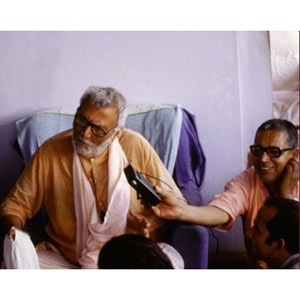


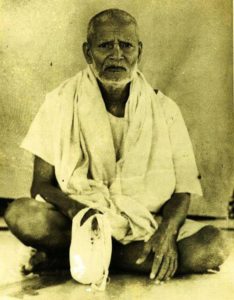 We know that Kṛṣṇa Dās Bābājī Mahārāj has left this world. We would like to remember his life and activities as much as possible. I first met him in 1926 or so. I found him shortly after I joined Gauḍīya Maṭh. He returned from a preaching tour with Bhāratī Mahārāj at that time. He was young, smart, beautiful, jolly, and very firm in his principles, especially towards Nām-bhajan. He came from a respectable, high family from Dacca, [Munchi Ganga?], which at present is in Bangladesh. At that time it was all part of Bengal in British India. I next saw him when he came back with a preaching party from Naimiṣāraṇya and western parts of India with Bon Mahārāj. Some natural friendship grew between us. Perhaps our similar high social rank, similar education, similar simplicity, and similar earnestness for Kṛṣṇa consciousness brought us together, gradually and intimately. I had a closer connection with him in the latter part of ’27 in New Delhi.