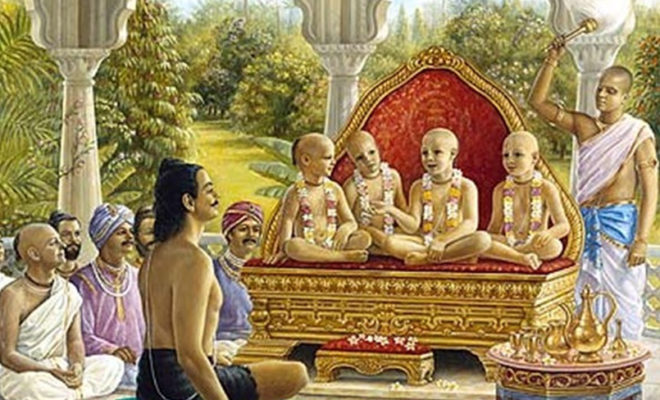
The Glories of Purusottam Month (adhi-masa)

Srila Bhaktivionda Thakur In this article “The Glories of Puruṣottama Māsa”, Ṭhākura Bhaktivinoda describes the glories of the holy month of Puruṣottama according to the śāstras, how to observe it and the true goal in following it.

Puruṣottama Māsa Māhātmya
(The Glories of Puruṣottama Māsa)
by Śrīla Bhaktivinoda Ṭhākura

Two divisions of śāstra—smārta and paramārtha

The Vedic ārya–śāstras are divided into two sections — smārta (literature based on smṛti) and paramārtha (transcendental literature based on śruti). Those who are eligible (adhikārī) for the smārta section do not have any natural inclination or taste for the paramārtha–śāstras. The thoughts, principles, activities, and life goal of every human is constituted according to his respective ruci (inclination). Generally, smārtas accept those scriptures which are in accordance with their respective ruci. Having greater adhikāra for smārta–śāstra, they do not demonstrate much regard for paramārthika–śāstra. Providence is the agent behind the creation of these two divisions. Therefore, undoubtedly the maintainer of the world must have a hidden purpose in having made such an arrangement.

Continue reading

Srila Haridas Thakur glory

Srila Haridas Thakur Bhajana Sthali Fulia, West Bengal.

About Srila Haridas Thakur in Sri Chaitanya Caritamrita madhya 11

As soon as Haridasa Thakura saw Sri Caitanya Mahaprabhu, he immediately fell down like a stick to offer Him obeisances, and Lord Sri Caitanya Mahaprabhu raised him up and embraced him. Then both the Lord and His servant began to cry in ecstatic love. Indeed, the Lord was transformed by the qualities of His servant, and the servant was transformed by the qualities of his master.
Haridasa Thakura said, “My dear Lord, please do not touch me, for I am most fallen and untouchable and am the lowest among men. The Lord said, “I wish to touch you just to be purified, for your purified activities do not exist in Me.

Sri Caitanya Mahaprabhu exalted Haridasa Thakura, stating, “At every moment you take your bath in all the holy places of pilgrimage, and at every moment you perform great sacrifices, austerity and charity.  “You are constantly studying the four Vedas, and you are far better than any brahmana or sannyasi.”

Overcome namabhasa

Srila Bhakti Vinod Thakur’s DIVINE WORDS

“In order to overcome namabhasa and get the pure name, the jiva must serve the bona fide guru with great attention. By doing this the anarthas will disappear and the pure name endowed with all spiritual potency will dance on the devotee’s tongue. At that time, he will never give up the stream of sweet nectar emanating from the holy name; the jiva will chant constantly, mad with the sweetness of the name. In joy the name will dance, the jiva will dance, and the treasure of love of God will dance—the whole universe will dance and maya will flee.

(Sri Harinam Cintamani)

Sri Mukundamala Stotram

Mahaprabhu reciting in front of Sri Jagannath

jayatu jayatu devo devakī-nandano ‘yam
jayatu jayatu krishno vrishni-vamśa-pradīpah
jayatu jayatu megha-śyāmalah komalāńgo
jayatu jayatu prithvī-bhāra-nāśo mukundah

TRANSLATION

All glories to this Personality of Godhead known as the son of Śrīmatī Devakī devī! All glories to Lord Śrī Krishna, the brilliant light of the Vrishni dynasty! All glories to the Personality of Godhead, the hue of whose soft body resembles the blackish color of a new cloud! All glories to Lord Mukunda, who removes the burdens of the earth!

Consciousness means endowed with free will

“Consciousness means endowed with free will, for without free will no consciousness can be conceived.

An atomic pinpoint of consciousness has very meager free will, and by misuse of their free will some jivas have taken their chance in the material world. They refused to submit to the supreme authority; they wanted to dominate. So, with this germinal idea of domination, the jiva enters into the world of exploitation.


In the Bhagavad-gita (7.27) it is stated:

iccha-dvesa samutthena
dvandva-mohena bharata
sarva-bhutani sammoham
sarge yanti parantapa

“Two principles in a crude form awaken in the jiva: hatred and desire. Then, gradually the soul comes down to mingle with the mundane world.”

Continue reading

Uddhava-Gita 10.42

Udhava Gita Uddhava-Gita

TEXT 10.42|| SB 11.16.42

vacam yaccha mano yaccha pranan yacchedriyani caatmanam atmana yaccha na bhuyah kalpase ‘dhvane

Therefore, control your speech, subdue the mind, conquer the life air, and regulate the senses, and bring your rational faculties under control by means of purified intelligence. By doing so, you will never again fall down to the path of material existence.


Continue reading

Srimad Bhagavatam 1.8.36

Srimad Bhagavatam 1.8.36

This sloka Sri Kunti Devi saying to Krishna.

śrinvanti gāyanti grinvanty abhīksnaśaḥ
smaranti nandanti tavehitaṁ janāḥ
ta eva paśyanty acirena tāvakaṁ
bhava-pravāhoparamaṁ padāmbujam

Translation:

O Krishna, those who continuously hear, chant and repeat Your transcendental activities, or take pleasure in others’ doing so, certainly see Your lotus feet, which alone can stop the repetition of birth and death.

Bhaja Re Bhaja Re Amar

Song: Bhaja Re Bhaja Re Amar

Official Name: Bhajan Gita Song 1

Author: Bhaktivinoda Thakura

Book Name: Gitavali


play_circle_filled
pause_circle_filled
Bhaja Re Bhaja Re Amar
save_alt
volume_down
volume_up
volume_off

1)
bhaja re bhaja re āmār mana ati manda
(bhajan vinā gati nāi re)
(bhaja) braja-bane rādhā-kṛṣṇa-caraṇāravinda
(jñāna-karma parihari’ re)
(bhaja) (braja-bane rādhā-kṛṣṇa)
Continue reading

2020-08-03 Sri Balaram Purnima and Srila Gurumaharaja Vyasapuja


Sri Baladeva Purnima and Sri Guru Puja of Srila Bhakti Prapanna Tirtha Goswami Maharaj!
 
Harikatha of Srila Bhakti Prapanna Tirtha Goswami Maharaj, Sripad Bhakti Kamal Tyagi Maharaj, Swami B.A. Paramadvaiti Maharaj and other devotees.


2020-08-03 India, SREE CAITANYA SRIDHAR SEVA ASHRAM, Nabadwip.


Continue reading

Mā Muñcha-Pañcha-Daśakam

Srila Bhakti Raksak Sridhar Dev-Goswami MaharajMā Muñcha-Pañcha-Daśakam

Composed by
Śrīla Bhakti Rakṣak Śrīdhar Dev-Goswāmī Mahārāj

Originally Published in Śrī Gauḍīya-darśan
Volume 12, Issue 6, Thursday 12th January, 1967

mā muñcha muñcha māṁ kṛṣṇa! dāsaṁ dīna-dayārṇava!
patitaṁ ghora-saṁsāre hy avaśaṁ prakṛter vaśat [1]

mā–do not; muñcha–abandon; muñcha–deliver; māṁ–me; kṛṣṇa!–oh Kṛṣṇa!; dāsaṁ–servant; dīna–destitute; dayā–(of) mercy; arṇava–ocean; patitaṁ–fallen; ghora–terrible; saṁsāre–in the material world, within conditioned life, within mundane family life; hi–certainly; avaśaṁ–helplessly, unwillingly; prakṛteḥ–by material nature; vaśat–under control.

Don’t abandon me. Deliver this servant. Oh Kṛṣṇa! Oh ocean of mercy for the destitute! Helplessly subjugated by material nature, I am fallen within this terrible world.

Continue reading